How I Cut Event Marketing Time in Half with an AI Workflow
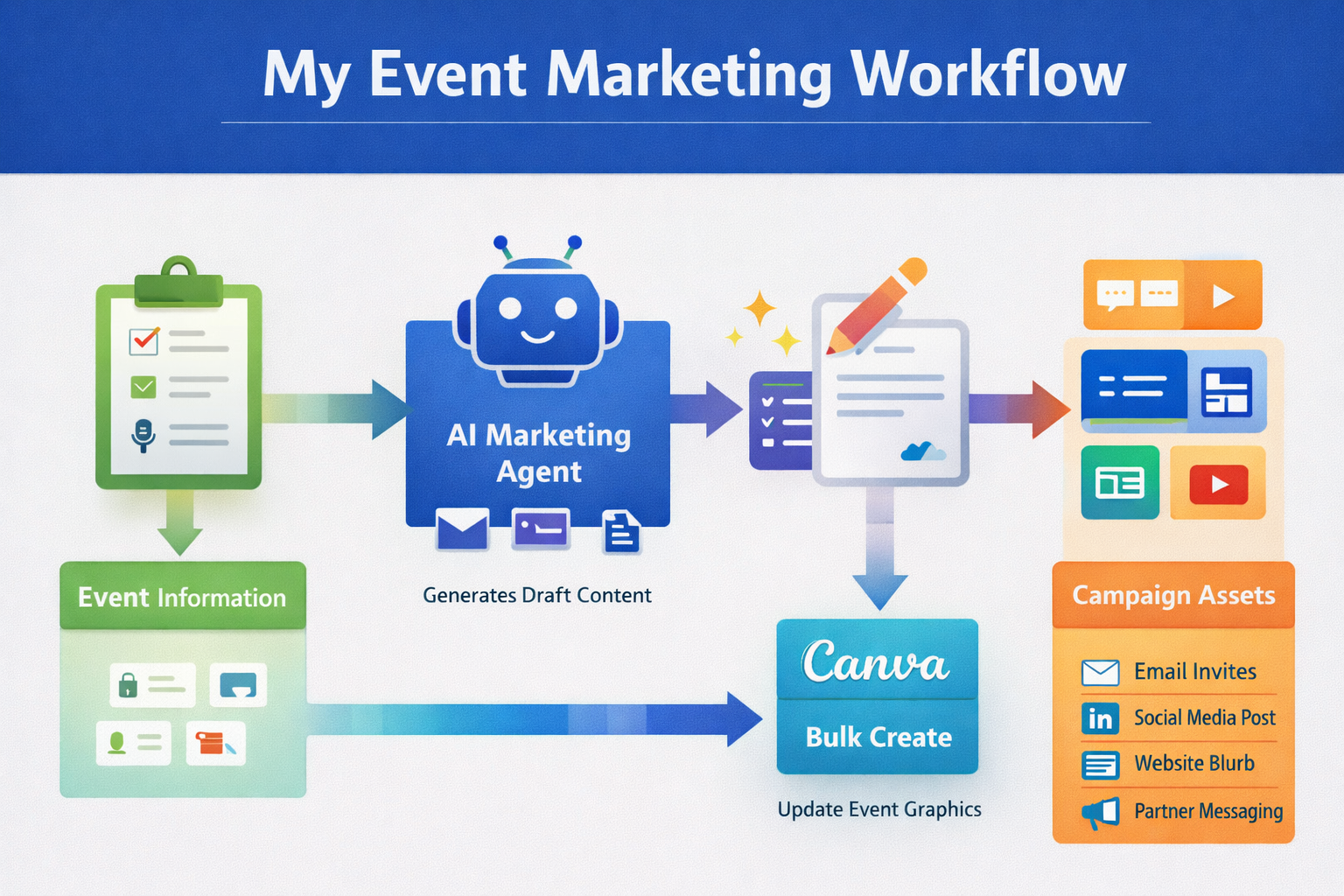
Not long ago, promoting a single event would take me somewhere between four and eight hours.
Writing email copy, creating social posts, building event pages, updating graphics, preparing blurbs for partners — none of those tasks were particularly difficult, but together they could easily consume most of a workday.
Recently, that process dropped to about three hours.
The reason wasn’t working faster. It was realizing something simple: most marketing campaigns follow repeatable patterns, and those patterns are perfect candidates for automation.
The Context: A Team of One
In my role, I support the marketing and communications efforts for a university technology commercialization office. I work closely with teams in business development, outreach, and program management, but when it comes to marketing, I’m the only marketer in the office.
That means every campaign — events, program announcements, newsletters, digital content — typically starts with me.
Because of that, I’m always looking for ways to make marketing work more repeatable and scalable. If every campaign requires starting from scratch, it becomes very easy to run out of time.
Events are a good example of this. Each one requires a similar set of materials:
email invitations
website copy
LinkedIn and social posts
partner promotion blurbs
promotional graphics
YouTube descriptions and post-event promotion
Even though the content changes, the structure of the campaign rarely does.
Once I noticed that pattern, I started experimenting with ways to make the process more efficient.
Building an AI-Assisted Marketing Workflow
Instead of writing every piece of campaign content manually, I created a structured prompt system that works like a small marketing assistant.
When information about an upcoming event is shared with me, I input the key information:
event title
event description
speakers
date and time
registration link
From there, the system generates first drafts for the marketing materials I usually need, including:
email campaign copy
social media posts
website blurbs
partner promotional copy
YouTube video descriptions
These drafts are never final. I still edit the tone, refine the messaging and make sure everything aligns with the goals of the program.
But instead of starting from a blank page each time, I start with something that’s already 80% of the way there.
That alone removed a lot of the friction from campaign production.
Where AI Actually Helps in Marketing
There’s a lot of conversation right now about AI replacing marketing work.
My experience has been different.
The real value of AI isn’t replacing creative thinking — it’s helping remove the predictable, repetitive parts of the process.
Event marketing is a good example of this. Most campaigns follow a recognizable structure:
announcing the event
creating promotional assets
distributing content across channels
supporting partners with messaging
Once you see that pattern, it becomes much easier to design systems that support it.
That’s where tools like AI assistants started to make sense to me.
Canva Bulk Create Changed the Graphic Workflow
The other major time saver came from something much simpler: Canva’s Bulk Create feature. I am grateful I stumbled upon this feature!
For most events, I use a consistent set of graphic templates. The visual design stays the same while the event information changes.
Previously, updating those graphics still meant opening each file and manually replacing the text.
With Bulk Create, I can connect a spreadsheet with the event information and automatically populate multiple versions of the design in seconds. Titles, speakers, subtitles, and dates update across templates almost instantly.
It’s a small feature, but when you’re producing graphics frequently, it eliminates a surprising amount of repetitive work.
The Result: Campaign Production Became Faster
Combining structured AI drafts with Canva’s Bulk Create changed how I approach event marketing.
What used to take a full day or more now typically takes around three hours from content creation to distribution.
More importantly, the work feels different.
Instead of spending most of my time drafting routine materials, I can focus more on the parts that actually require human judgment:
refining the message
thinking about the audience
coordinating with partners
analyzing how campaigns perform
The system doesn’t remove the work — it simply removes the friction.
What This Experiment Reinforced for Me
One thing I’ve learned working in marketing is that the job is constantly changing.
New platforms appear. Algorithms shift. New tools promise to transform how we work. AI is just the latest example.
Because of that, I’ve never thought of marketing expertise as something static. It’s more of an ongoing learning process.
Experiments like this are small ways of adapting to that constant change.
The goal isn’t to automate creativity. It’s to build better systems that leave more time for the parts of marketing that actually require human thinking: understanding audiences, shaping messages and collaborating with others.
For someone running marketing campaigns across multiple programs — especially as a team of one — that shift makes a big difference.